Description
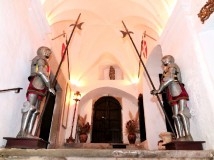
The entrance of the castle is made by wide arches -the feudal lords used to enter on horses; that explains the purpose of the stone bench: to facilitate mounting and dismounting on the horses of the vigorous lords wearing uncomfortable armours -and the loopholes, sign of the defensive character of the fortress. A chimney provided heating to the soldiers guarding, and the following big hall was used for quartering the rest of the protection troop.
Going up the main staircase, of obvious Renaissance style, one gets to the library. The current library previously had other purposes: it was used as a church, or as a school for the people of the town, if the proper ones were on construction; it was also used for billeting the troops when the Castle was used exclusively for military purposes… The weapons on exhibition over the door show that this room has not always been used for reading or studying.
Other staircase leads us to the noble floor. Its steps made of stone, its dome above, and the openings in the form of balconies that connect with the staircase, made us deduce that it had the typical function of the interior courtyards of the seigniorial houses: to be the living centre and meeting point of the castle.
And we get to the terrace, from where the Lords of Montclar surely used to watch their lands. A well, possibly from Arab 'engineering', picks up the water of the rain, stores it and distributes it through the wholes on the stones, with the option of sending it to the exterior, when there is abundance, to clean the façade if necessary. Definitely, high technology of the time! There we also find, attached to the building, the 'sanitary' column, where there are the latrines. And also from the terrace, one can see that the church forms part of the building. This shows the typical close relationship between the nobility and the clergy, which had its expression in the fact that a part of the Castle was transformed into the church.
In the great hall, 6 and half metres high, there is a collection of paintings, portraits of the ancestors of the owners of the castle. Once again the revolving loopholes below the windows and a kneecap, also revolving, show the necessity of being ready to defend the castle of any attack.
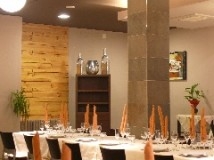
Oriented to the south, we find the dinning room, with a wooden table of only one piece, benches surrounding the chimney and an arch typical of the Valley of Aran over the entrance. It would be quite curious to contemplate the evening parties, noble evening parties, which happened in this comfortable room. Finally, a corridor full of family portraits of the De Miguels leads to the bedrooms: the golden bedroom (the word 'golden' comes from de colour of the beds), the office (where the family in charged of the service would live, on this floor, with a bedroom next, and receiving the food from the kitchens on a freight elevator) and, finally, the small room that, due to being oriented to the north, is the fresher place of the building, where one can deduce, the inhabitants used to be most of the time during summer.
And again back to the main staircase; if instead of going up we go downstairs, we find another floor, with the private areas: the kitchen, the laundry, the wine press, and three of the 17 bedrooms that are in the castle. Finally, the prison, the wine cellar and the garage complete the different areas of the fortress. The cellar was very useful during the times when the wine production in Montclar was very relevant: a Romanic tower from the II century, of which only this piece is preserved, and which before was the homage tower, then the prison and finally the cellar.
|
A small window of the present library permitted to watch over the interior of the prison, without those nearby realizing it. In fact, this "eye of ox" comes from even more previous times; when the wall connected to the exterior, this little hole, with an excellent shooting angle, was quite efficient to defend the castle of possible attacks. These loopholes are composed of a large hole in a revolving stone, which could be closed when it was not used. There is no other known castle with this sophisticated system.
|